Approved by Assessment Committee May 30, 2018.
Revised and Approved May 17, 2022.
Revised and Approved Dec 9, 2025.
Purpose
At the UW–Madison School of Pharmacy, we want every student to succeed. In some cases, a student may struggle in a course but still have the potential to meet the learning goals. When this happens, remediation gives the student a chance to show they understand the material without retaking the whole course.
Remediation is only offered when a student earns a failing final course grade (“F”) and is at the discretion of the course coordinator. Remediation is not a way to improve a passing course grade or skip ahead without mastering the content. Remediation is meant to help students continue to move forward in the program while making sure they have learned what they need to know. This policy and its procedures are not impacted by in-course remediation opportunities that an instructor may offer.
This policy supports clear communication between students, instructors, and advisors, and ensures fair and consistent decisions. It also meets Accreditation Council for Pharmacy Education’s Standards 2025 4.4.a.
Who Can Remediate
- Remediation is only available for required didactic PharmD courses to students meeting the remediation criteria outlined in the course syllabus. (Elective courses are not eligible)
- Students must have earned a final grade of “F” in the course
- Students earning a “D” or better are NOT eligible for remediation
- Students must be in good academic standing as defined by SPARC
- Students can remediate one course per semester, up to two times total during the PharmD program.
Grades and How Remediation Works
- PharmD students receive an “IF” (Intermediate Fail) grade instead of an “F” if the student has met the remediation criteria outlined in the course syllabus. This is a temporary grade.
- Instructors must apply the “IF” grade consistently to all eligible students in their course.
- Students get one opportunity to remediate a course grade—usually through a re-exam or other assessment.
- If the student does not pass, the final grade becomes a permanent “F”. The student must repeat the course as outlined in the Student Promotion Policy.
- If the student passes, the final grade becomes a “D”. No higher grade can be earned through remediation.
- Students affected by the Remediation Policy should also refer to the Student Promotion and Academic Review Committee policies and procedures.
Remediation Procedures
Checklist by Role
Instructor
- Include remediation policy link in the course syllabus and any additional eligibility requirements
- Calculate final grades and list of remediation-eligible students per the syllabus guidelines. Submit “IF” grades for eligible students.
- Confirm with Vice Chair of SPARC if a student is eligible to remediate the course
- Create a written remediation plan with assessment type, passing criteria, and deadline
- Share the plan with the student, advisor, and SPARC chair(s) within 7 business days of the end of the semester
- Organize, administer, and grade the remediation assessment
- Submit grade change from “IF” to “D” or “F” based on outcome
- Notify Vice Chair of SPARC of the final grade change
Student
- Talk with the course coordinator to confirm eligibility
- Accept or reject the remediation plan in writing
- Complete all remediation tasks by the deadline
- Meet with advisor in future semesters to review progress
- Seek assistance as needed in future courses that build on remediated material
Vice Chair of SPARC
- Track final grades and monitor “IF” grades
- Keep a copy of the signed remediation plan and outcome
- Share remediation trends with the Assessment Committee and SPARC
Assistant Dean of Assessment and Academic Planning
- Keep records of student performance and remediation outcomes
- Monitor students who have remediated courses
Committees (Assessment, Curriculum, SPARC)
- Review and evaluate the effectiveness of remediation policies
PharmD Handbook Sections
This is an accordion element with a series of buttons that open and close related content panels.
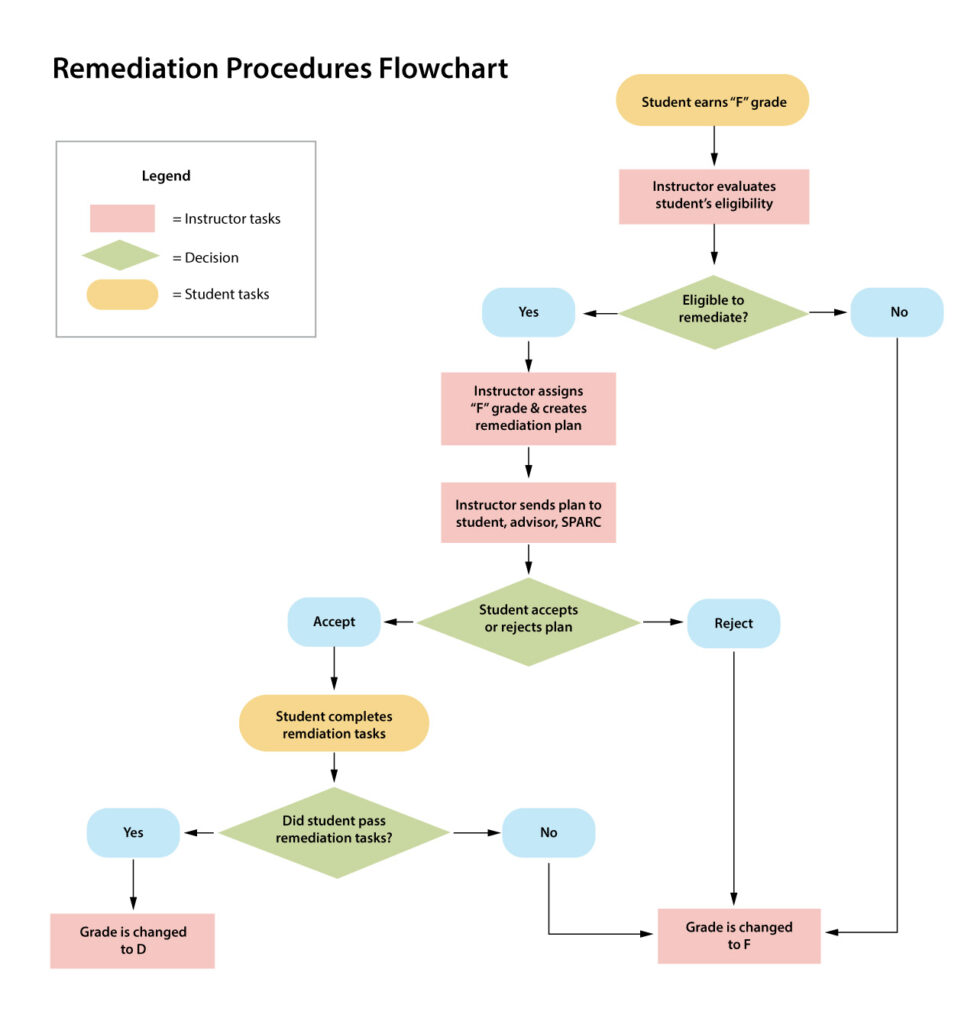
Flow Chart Outline Description
Title: “Remediation Process Flow Chart”
- Top of chart begins: “Student earns F grade.”
- Next: “Instructor evaluates student’s eligibility for remediation.”
- Next: Q: “Student eligible to remediate?”
- If “No”, then: Grade is changed to F.”
- If “Yes”, then “Instructor assigns ‘F’ grade and creates remediation plan.
- Next: ” Instructor sends plan to student, advisor, and SPARC.”
- Next: “Student accepts or rejects plan.”
- If “Reject”, then “Grade is changed to F.”
- If “Accept”, then “Student completes remediation tasks.”
- Next: “Did student pass remediation tasks?”
- If “No”, then “Grade is changed to F.”
- If “Yes”, then “Grade is changed to D.”
- Next: “Did student pass remediation tasks?”